A hearing aid makes sound louder and sends it down the ear canal, so it needs some working hair cells in the inner ear. A cochlear implant skips those damaged hair cells and stimulates the hearing nerve directly with electrical signals. Most people, including many with severe hearing loss, do well with a properly fitted power hearing aid. An implant is meant for those who still cannot follow speech with the best hearing aids. In India an implant costs about ₹5 to ₹12 lakh, against roughly ₹19,000 to ₹3.6 lakh per ear for a power hearing aid.
We should say this upfront: Hearwell does not sell or fit cochlear implants. We fit hearing aids. That makes us a little more honest on this topic than you might expect, because a large share of the people who come to us asking about implants were never given a proper chance with the right hearing aid. Others really do need an implant, and for them we arrange a referral to an ENT surgeon and implant centre. This guide is meant to help you work out which group you are in.
At a Glance
- Hearing aid: amplifies sound. Works when the inner ear can still use louder sound. No surgery.
- Cochlear implant: a surgically placed electrode array plus an outer sound processor. It replaces the job of the damaged hair cells.
- An implant is usually considered for severe to profound sensorineural loss in both ears, when speech understanding stays poor even with well-fitted hearing aids.
- Cost in India: about ₹5 to ₹12 lakh for an implant, plus processor upgrades every few years. Power hearing aids run from ₹18,990 to ₹3,64,990 per ear.
- Children from low-income families may get implant support of up to ₹6 lakh under the central ADIP scheme, and several states run their own schemes.
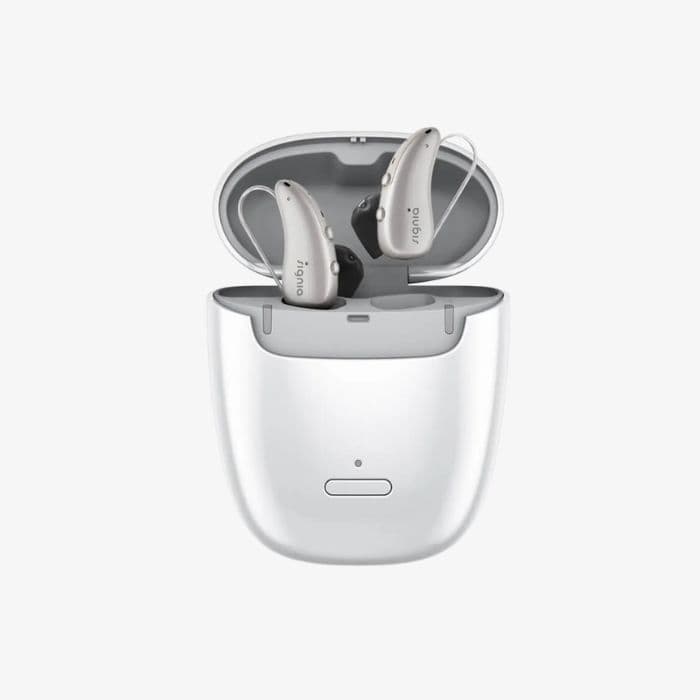
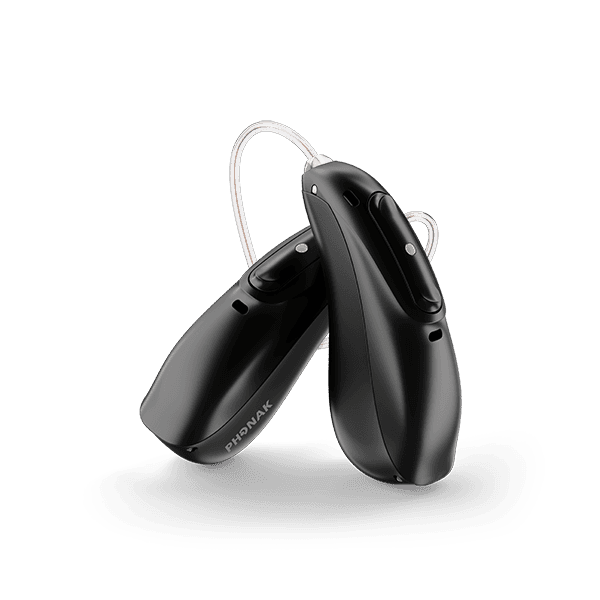
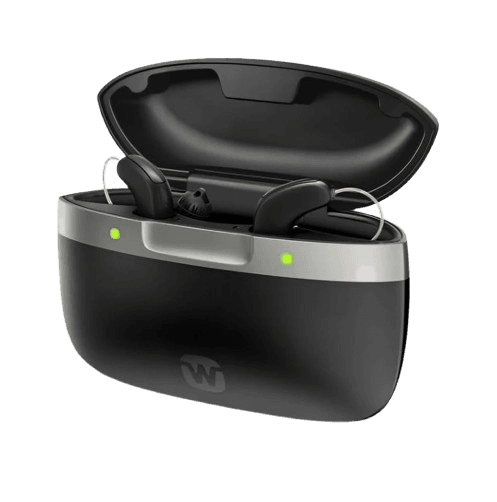
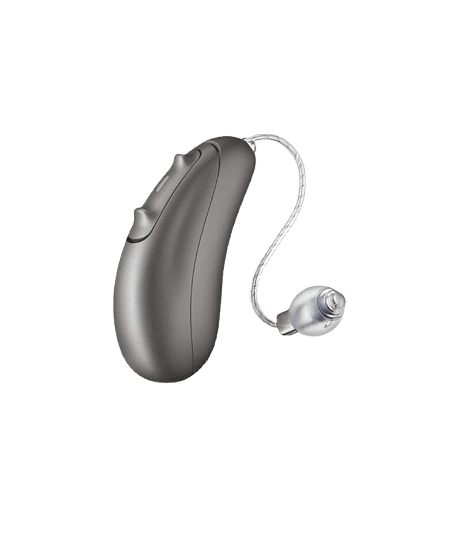
- Our top 5 power hearing aids to try first: Phonak Naída Lumity, Signia Motion Charge&Go IX SP, Oticon Xceed, Bernafon Leox UP and Signia Intuis 3 SP.
How a Hearing Aid and a Cochlear Implant Work
Normal hearing depends on thousands of tiny hair cells in the cochlea, the snail-shaped part of the inner ear. They turn sound vibrations into nerve signals. In sensorineural hearing loss, many of these cells are damaged or lost, and they do not grow back.
A hearing aid picks up sound with its microphones, processes it, makes the parts you cannot hear louder and plays it into the ear canal. The remaining hair cells do the rest. Modern digital aids do much more than turn up the volume: they separate speech from noise, shape the sound to your audiogram and stream phone calls. You can read more in how hearing aids work.
A cochlear implant has two parts. A surgeon places a receiver under the skin behind the ear and threads a thin electrode array into the cochlea. Outside, a sound processor that looks a bit like a large hearing aid sits on the ear, with a round coil held to the head by a magnet. The processor turns sound into electrical pulses that go straight to the hearing nerve. Nothing is made louder; the brain learns to read a new kind of signal.

Cochlear Implant vs Hearing Aid: The Key Differences
| Hearing aid | Cochlear implant | |
|---|---|---|
| How it works | Amplifies sound for the inner ear | Electrical signals straight to the hearing nerve |
| Surgery | None | Yes, under general anaesthesia |
| Usual hearing loss | Mild to severe, many profound | Severe to profound, with poor speech scores |
| Trial before buying | Yes, at home | No; the decision is final once implanted |
| Natural residual hearing | Kept | May be reduced in the implanted ear |
| Getting used to it | A few weeks | Months of mapping and therapy |
| Cost in India | ₹18,990 to ₹3.6 lakh per ear (power models) | About ₹5 to ₹12 lakh per ear |
| Lifetime extras | New aid every 5 to 6 years | Processor upgrades, spares, batteries, therapy |
The most important row is the trial. You can take a hearing aid home, use it for a week, change the settings or return it. An implant is a one-way step for that ear, so it makes sense to be sure that a good hearing aid really cannot do the job first.
Who Actually Needs a Cochlear Implant?
Implant centres look at more than the audiogram. In broad terms, an adult is usually considered when all of these apply:
- Severe to profound sensorineural hearing loss, typically 70 dB or worse, in both ears (some centres now also implant one ear in single-sided deafness).
- Poor speech understanding even with well-fitted hearing aids. US criteria, which many Indian centres follow, use a best-aided sentence score of about 40 to 60 percent or lower.
- A healthy hearing nerve and a cochlea that can take the electrode, checked on CT and MRI scans.
- Fit for surgery, and willing to commit to months of follow-up and listening practice.
For children the timing matters more. A child born with profound loss in both ears who gets little from hearing aids is usually implanted early, often between 1 and 3 years, because the brain’s window for learning spoken language narrows with age. Even so, a hearing aid trial normally comes first, and newborn screening is what makes early action possible.
Who is better off with a hearing aid
Mild, moderate and most severe hearing loss is a hearing aid job. So is almost all conductive loss, where the problem is in the outer or middle ear rather than the cochlea. And so is anyone whose speech score improves clearly with amplification. If your aided score is good, an implant is unlikely to beat it.
We also see a common pattern: someone with severe loss has worn a basic, weak or poorly fitted hearing aid for years, gets little from it, and decides they must need an implant. When we fit a proper power aid with a custom earmold and fine-tune it over a few visits, many of them hear speech far better than before. That is why the trial in the next section matters.
Cochlear Implant Cost in India (2026)
Hospital estimates for one ear range from about ₹5 lakh to ₹12 lakh, depending on the city, the hospital and the implant brand and model. Care Hospitals lists ₹5 to ₹12 lakh across India, and Manipal Hospitals gives ₹6.5 lakh to ₹12 lakh, with metro hospitals at the top of the range. The figure usually includes the implant, the processor and the surgery, but check what is excluded.
| Cost item | What to expect |
|---|---|
| Implant + processor + surgery (one ear) | About ₹5 to ₹12 lakh |
| Tests before surgery (CT, MRI, hearing and speech tests) | Extra at many hospitals; ask for a written estimate |
| Mapping (programming) visits | Several in the first year, then yearly |
| Auditory-verbal or speech therapy | Often two to four years for children |
| Processor replacement or upgrade | Every few years once the warranty ends; can run into lakhs |
| Batteries, cables, coils and spares | Ongoing yearly cost |
For a fair comparison, a pair of power hearing aids costs anywhere from about ₹38,000 (two Signia Run SP) to around ₹6.5 lakh (a premium Signia Motion pair kit). Even at the top end, that is less than one implant, and the aids can be tried before you pay.
Government help for implants
The central ADIP scheme has funded cochlear implants for young children from low-income families, with a ceiling of ₹6 lakh per unit under its 2014 revision. Several states run their own programmes too: Madhya Pradesh has the Mukhya Mantri Bal Shravan Yojana, and Kerala, Tamil Nadu and Rajasthan have provisions for upkeep and upgrades. Rules, age limits and income limits change, so check with your district disability office or the implant centre. For hearing aids, retired central government staff can look at our CGHS reimbursement guide.

Top 5 Power Hearing Aids to Try Before a Cochlear Implant
These are the models we would put on a person with severe to profound loss before talking about surgery. All five are behind-the-ear power aids that reach 110 to 120 dB fitting ranges. Prices are MRP per ear from the 2026 brand price lists, and Signia and Phonak come first because they are the two brands Hearwell focuses on.
| # | Model | Type | Best for | Price per ear (₹) |
|---|---|---|---|---|
| 1 | Phonak Naída Lumity (L-PR / L-UP) | Power BTE, rechargeable or battery | Severe to profound loss | 63,000 to 3,23,000 |
| 2 | Signia Motion Charge&Go IX (SP) | Power BTE, rechargeable | Severe loss, speech in groups | 72,990 to 3,64,990 |
| 3 | Oticon Xceed 3 SP | Super power BTE, battery | Severe to profound loss | 49,000 |
| 4 | Bernafon Leox 3 BTE UP | Ultra power BTE, battery | Profound loss, up to 120 dB | 49,990 |
| 5 | Signia Intuis 3 SP | Power BTE, battery | Budget power option | 26,990 |
1. Phonak Naída Lumity (L-PR and L-UP)

Naída is the hearing aid audiologists most often fit when a loss approaches implant territory. The rechargeable L-PR covers moderate to profound loss and costs ₹77,000 to ₹3,23,000 per ear with charger, or ₹1,38,000 to ₹6,30,000 for a pair kit. For the strongest power, the battery-powered L-UP is built for severe to profound loss and runs ₹63,000 to ₹3,00,000. Phonak and the implant maker Advanced Bionics belong to the same group, so Naída is also a natural partner in the other ear for someone who later gets an AB implant. See the Phonak price guide for the full range.
2. Signia Motion Charge&Go IX (SP)

Motion IX gives severe loss the same IX processing as Signia’s best RIC aids, including the feature that keeps several talkers around you in focus while turning down background noise. The SP size reaches a 120 dB fitting range, it is rechargeable and it has a push button that older hands can find. Prices run ₹72,990 to ₹3,64,990 per ear. If you need it on a tighter budget, the previous Motion X range starts at ₹59,990. The Signia price guide and Signia IX vs AX explain the levels.
3. Oticon Xceed 3 SP

Xceed is Oticon’s dedicated family for severe to profound loss, designed to give a lot of gain while controlling feedback. On the 2026 list the Xceed 3 SP costs ₹49,000 per ear, which makes it one of the most affordable branded super power aids. More Oticon models and prices are in our Oticon price guide.
4. Bernafon Leox 3 BTE UP

Bernafon is less well known in India, but its Leox UP is a serious option for profound loss. The UP version lists a fitting range up to 120 dB, against 110 dB for the SP, and Bernafon labels it for children as well as adults. The Leox 3 SP and UP cost ₹49,990 per ear. You can browse other Bernafon models on our site.
5. Signia Intuis 3 SP (best on a budget)

A power hearing aid trial should not need a lakh of rupees. Intuis 3 SP has 12 channels and a 20 to 120 dB fitting range for ₹26,990 per ear. It has no Bluetooth or recharging, but it gives honest power and is an easy way to test how much a properly fitted aid helps before spending more. Even simpler, Signia Run SP covers 60 to 120 dB for ₹18,990. Our top 10 BTE hearing aids list has more power options.
How to Know if a Hearing Aid Is Really Not Enough
A fair hearing aid trial is not just wearing any aid for a few days. Before anyone decides that hearing aids have failed, these steps should be done:
- A full audiogram with speech tests, so you know both how loud sound must be and how clearly you understand words.
- A power aid that matches the loss, fitted to a prescription target and checked with real-ear measurement where possible.
- A custom earmold. With severe loss, a generic dome lets sound leak and causes whistling, so the aid never gets loud enough.
- Daily, all-day use for at least six to eight weeks, with fine-tuning visits in between.
- An aided speech test at the end. If you still score poorly on sentences in quiet with both aids on, it is time to see an implant team.

Hearwell offers this whole process. If the trial shows a hearing aid cannot give you clear speech, we will tell you plainly and refer you to an ENT surgeon for an implant assessment. Our guide to choosing a digital hearing aid covers the fitting side in more detail.
Can You Use a Cochlear Implant and a Hearing Aid Together?
Yes, and many people do. When one ear is implanted and the other still has some usable hearing, a hearing aid in that second ear is called a bimodal fitting. The hearing aid adds low-pitched sound and natural warmth while the implant gives clarity, and together they usually help with music and with speech in noise. This is one more reason to keep a good power aid in the picture even after an implant.
Risks and Limits of Each Option
A hearing aid carries almost no medical risk. Its limits are about the ear: if too many hair cells are gone, louder sound just becomes louder noise, and speech stays unclear however good the aid is. That is exactly the point where an implant helps.
An implant is generally safe surgery, but it is still surgery. There are small risks of infection, dizziness, taste changes, facial nerve problems and device failure, and natural hearing left in the implanted ear may be reduced. Results vary a lot from person to person. Adults who lost hearing after learning to speak usually do best; adults deaf since birth often get less benefit. MRI scans also need extra care with the implant magnet. A good implant team will go through all of this with you.
Get a Power Hearing Aid Trial at Hearwell
If you or a parent has been told an implant is the only option, it is worth getting a second opinion on the hearing aid side first. Hearwell clinics test your hearing, fit power aids from Phonak, Signia, Oticon and Bernafon to your audiogram and let you try them at home for 7 days. Visit us in Jalandhar, Phagwara, Kapurthala, Ludhiana, Bathinda, Mohali, Patiala or Jammu, or contact us to book. You can also compare the models above in the compare tool or read our hearing aid price guide and Signia vs Phonak comparison.
Frequently Asked Questions

What is the difference between a cochlear implant and a hearing aid?
A hearing aid makes sound louder so the remaining hair cells in the inner ear can use it. A cochlear implant is surgically placed and sends electrical signals straight to the hearing nerve, bypassing damaged hair cells. Hearing aids need no surgery; implants are for severe to profound loss when hearing aids no longer give clear speech.
Which is better, a cochlear implant or a hearing aid?
Neither is better for everyone. For mild to severe hearing loss a hearing aid is better because it needs no surgery and keeps natural hearing. For profound loss where speech stays unclear even with the best hearing aids, an implant usually gives better speech understanding.
What is the cost of a cochlear implant in India?
In 2026 a cochlear implant costs about ₹5 lakh to ₹12 lakh per ear in India, depending on the city, hospital and implant model. Processor upgrades, spares and therapy add to the lifetime cost.
Who is eligible for a cochlear implant?
Usually adults and children with severe to profound sensorineural hearing loss in both ears who get limited benefit from well-fitted hearing aids, with a healthy hearing nerve on scans. Many centres use a best-aided sentence score of about 40 to 60 percent or lower as a guide for adults.
Can a hearing aid work for severe or profound hearing loss?
Often yes. Power and ultra power BTE hearing aids such as Phonak Naída, Signia Motion SP, Oticon Xceed and Bernafon Leox UP reach fitting ranges of 110 to 120 dB. A proper fitting with a custom earmold makes a big difference.
Is there a free cochlear implant scheme in India?
The central ADIP scheme has supported cochlear implants for young children from low-income families, with a ceiling of ₹6 lakh per unit, and several states have their own schemes. Eligibility rules change, so check with your district disability office or an implant centre.
Can you wear a hearing aid with a cochlear implant?
Yes. Wearing an implant in one ear and a hearing aid in the other is called bimodal hearing, and it often helps with music and speech in noise. Phonak Naída is a common choice for the hearing aid ear.
Does Hearwell do cochlear implant surgery?
No. Hearwell fits hearing aids. If a hearing aid trial shows you need an implant, we refer you to an ENT surgeon and implant centre for assessment.
Told You Need an Implant? Try a Power Hearing Aid First
Book a free hearing test at any Hearwell clinic. We will fit Phonak Naída, Signia Motion and other power hearing aids to your audiogram and let you try them at home for 7 days, then give you an honest answer on whether an implant assessment is the next step.
Call: +91 8556086888 | WhatsApp: wa.me/+918556086888 | Find your nearest Hearwell clinic