Sensorineural hearing loss (SNHL) is hearing loss caused by damage to the inner ear or to the hearing nerve that carries sound to the brain. It is the most common type of permanent hearing loss, it usually cannot be reversed with medicine or surgery, and for most people the treatment that works is a well-fitted hearing aid.
If an ENT doctor or audiologist has just written “bilateral SNHL” or “sensorineural” on your report, this page is for you. We go through what the term means, what causes it, how to read the degree on your audiogram, the one situation where treatment is urgent, and which hearing aids suit it, with 2026 India prices for Signia and Phonak first and other brands after.
At a Glance
- Sensorineural hearing loss means the inner ear (cochlea) or hearing nerve is damaged. Sound reaches the inner ear but is not turned into clear signals for the brain.
- Common causes: ageing, loud noise, some medicines, infections, genes, Meniere’s disease and head injury.
- Typical signs: speech sounds muffled, women’s and children’s voices are harder to follow, noisy rooms are tiring, and ringing in the ears is common.
- Most SNHL is permanent. Sudden hearing loss in one ear is the exception: see a doctor within days, because steroid treatment works best early.
- Hearing aids are the main treatment. Cochlear implants are for severe to profound loss where aids no longer help.
- Our top 5: Signia Pure Charge&Go IX, Phonak Audéo Infinio, Signia Motion Charge&Go IX, Phonak Naída L-PR and, on a budget, Signia Orion Charge&Go (from ₹32,990 a unit).
What Is Sensorineural Hearing Loss?
Your ear works in three parts. The outer and middle ear collect sound and pass it inward. The inner ear, a snail-shaped organ called the cochlea, is lined with thousands of tiny hair cells that turn those vibrations into electrical signals, and the hearing nerve carries the signals to the brain. In sensorineural hearing loss the trouble sits in that last stretch: hair cells are damaged or lost (the “sensory” part) or the nerve does not pass signals well (the “neural” part).

Hair cells in humans do not grow back, which is why this type of loss is usually permanent. People sometimes call it nerve deafness, though in most adults it is the hair cells, not the nerve, that are worn out. When both ears are affected, the report says bilateral SNHL; one ear only is unilateral.

Sensorineural vs conductive vs mixed hearing loss
Conductive loss is a different problem. Something stops sound reaching the inner ear, such as wax, fluid behind the ear drum, a hole in the drum or a stiff middle-ear bone (otosclerosis), and much of it can be fixed with medicine or surgery. Mixed loss is both at once. Our longer guide to types and causes of hearing loss covers all three; the table below is the short version.
| Conductive | Sensorineural | Mixed | |
|---|---|---|---|
| Where | Outer or middle ear | Inner ear (cochlea) or hearing nerve | Both |
| Common causes | Wax, fluid, infection, perforated drum, otosclerosis | Age, noise, medicines, genes, infection, Meniere’s | Chronic infection plus age or noise damage |
| Can it be cured? | Often, with medicine or surgery | Usually not, but it can be treated well | The conductive part often can |
| Main treatment | Medical or surgical | Hearing aids; cochlear implant if severe to profound | Treat the cause, then a hearing aid |
Causes of Sensorineural Hearing Loss
Age and noise account for most adult cases. The rest show up far less often, but they matter, especially when only one ear is affected.
- Age. Hair cells wear out slowly from our 40s and 50s onward, starting with the high pitches. This is called presbycusis and it affects both ears about equally. Our guide to hearing aids for senior citizens goes into it.
- Noise. Years in a factory, a printing press, a generator room or a band, and long hours on loud earphones, damage hair cells for good. A single very loud bang, such as firecrackers close to the ear, can do it too.
- Medicines that can harm the ear (ototoxic drugs), including some antibiotics such as gentamicin, some cancer drugs such as cisplatin, and high doses of certain other medicines. Do not stop a prescribed medicine on your own; ask the doctor who prescribed it.
- Infections: meningitis, mumps, measles, and infections passed from mother to baby such as rubella and CMV.
- Genes and hearing loss present from birth.
- Meniere’s disease, which brings attacks of vertigo, ringing and fluctuating low-pitch loss.
- Head injury, blood-flow problems, diabetes and, rarely, a benign tumour on the hearing nerve (acoustic neuroma). A loss in one ear only should always be checked by an ENT doctor for this reason.
Quite often no single cause is found. That is frustrating, but it rarely changes the treatment.
Symptoms: How Sensorineural Hearing Loss Feels
Most people do not notice it as “I can’t hear.” They notice that people seem to mumble. Because SNHL usually hits high pitches first, the soft consonants that carry meaning, like s, f, th and sh, fade while vowels stay loud, so speech is audible but not clear. Typical complaints:
- Hearing that someone is talking but not making out the words
- Women’s and children’s voices are harder than men’s
- Restaurants, weddings and family gatherings are exhausting
- Turning the TV up until others complain
- Ringing or buzzing in the ears (tinnitus); see hearing aids for tinnitus if that is your main problem
- Some loud sounds feel uncomfortably sharp, a sign called recruitment

How It Is Diagnosed, and How to Read the Degree

A pure-tone audiogram is the key test. The audiologist plays tones from low to high pitch and marks the softest level you can hear, first through headphones (air conduction) and then through a small vibrator behind the ear (bone conduction). When air and bone results are both poor and close together, the loss is sensorineural; a gap between them points to a conductive problem. Speech tests and tympanometry usually go with it.

The line on the chart drops as hearing gets worse. The degree is read from where the line falls, using the WHO grading:
| Degree | Hearing level (better ear) | What it is like | Usual hearing aid |
|---|---|---|---|
| Mild | 20 to 34 dB | Soft speech and quiet voices are missed | Small RIC, CIC or IIC |
| Moderate | 35 to 49 dB | Conversation is hard, especially in noise | RIC |
| Moderately severe | 50 to 64 dB | Normal speech is mostly missed | RIC with a power receiver, or BTE |
| Severe | 65 to 79 dB | Only loud speech is heard | Power BTE or power RIC |
| Profound | 80 to 94 dB | Even shouting is hard to hear | Super power BTE; implant assessment |
| Complete | 95 dB and above | Very little or no sound | Cochlear implant assessment |
Mild loss has its own guide on hearing aids for mild hearing loss. Most adults with SNHL fall somewhere between mild and severe, and that whole range is hearing aid territory.
Can Sensorineural Hearing Loss Be Cured?
In most cases, no. No tablet, drop, oil, exercise or surgery brings back damaged hair cells, and anyone selling a “permanent cure” for gradual SNHL is selling hope rather than medicine. Researchers are working on hair-cell regeneration and gene therapy, but none of it is a routine treatment you can get today.
What can be done is treat it well. With the right hearing aids, most people with mild to severe SNHL follow conversation comfortably again, and research also links treating hearing loss with lower strain on memory and thinking; our article on hearing loss and dementia explains that link.
The exception: sudden sensorineural hearing loss
If hearing drops in one ear over a few hours or up to three days, often noticed on waking, sometimes with a blocked feeling or ringing, treat it as urgent and see an ENT doctor straight away. The American Academy of Otolaryngology guideline advises a hearing test within 14 days and says steroids may be offered within two weeks of onset, with steroid injections behind the ear drum as a later option if recovery is incomplete. Some people recover partly or fully, and the chances are better the sooner treatment starts, so this is one hearing problem where waiting is a mistake.
Treatment Options for Sensorineural Hearing Loss
- Hearing aids, the main treatment for mild to severe and many profound losses. Modern digital aids boost exactly the pitches you are missing, by a different amount at each pitch, which is what SNHL needs. How hearing aids work explains the technology.
- Cochlear implants for severe to profound loss when hearing aids no longer make speech clear. This is a surgical treatment done by an ENT surgeon, and an audiologist can tell you if your results suggest an implant assessment.
- CROS hearing aids when one ear has no usable hearing and the other is fine or nearly fine. A small unit on the deaf side sends sound to the good ear.
- Tinnitus programmes and sound therapy, built into many aids, for the ringing that often comes with SNHL.
- Protection, to stop it getting worse: earplugs at work and at weddings, lower earphone volume, and reviewing ear-harming medicines with your doctor.
Top 5 Hearing Aids for Sensorineural Hearing Loss in India (2026)
We picked these from the 2026 brand price lists and each model’s published specifications, such as fitting range, rechargeability and noise handling. It is a starting shortlist, not a lab ranking. The right aid for you depends on your audiogram, your ear and your routine, so try before you buy.
Our top 3 picks
- Best overall for mild to severe SNHL: Signia Pure Charge&Go IX, a rechargeable RIC that separates voices from background noise well.
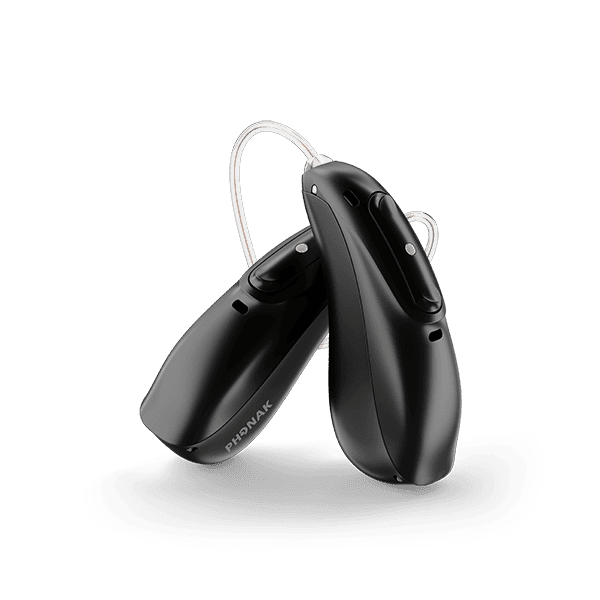
- Best Phonak RIC: Phonak Audéo Infinio, rechargeable, with wide phone compatibility.
- Best for severe to profound SNHL: Phonak Naída L-PR, a rechargeable power BTE.
The full top 5
| # | Model | Style | Best for | Price per unit (₹) |
|---|---|---|---|---|
| 1 | Signia Pure Charge&Go IX | RIC, rechargeable | Mild to severe SNHL, busy social life | 77,990 to 3,89,990 |
| 2 | Phonak Audéo Infinio (I-R) | RIC, rechargeable | Mild to severe SNHL, heavy phone users | 89,000 to 3,47,000 |
| 3 | Signia Motion Charge&Go IX | BTE, rechargeable (M, P, SP) | Moderate to severe SNHL, easier handling | 72,990 to 3,64,990 |
| 4 | Phonak Naída L-PR | Power BTE, rechargeable | Severe to profound SNHL | 77,000 to 3,23,000 |
| 5 | Signia Orion Charge&Go | RIC, rechargeable | Budget pick, mild to moderate SNHL | 32,990 to 42,990 |
1. Signia Pure Charge&Go IX

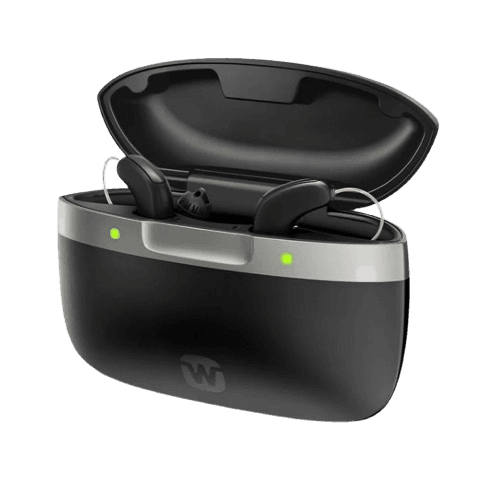
The Pure is a common first trial for moderate SNHL. Signia’s IX platform tracks several speakers around you and keeps their voices forward while turning down the clatter, which is the exact situation people with SNHL struggle in. It charges overnight and comes in five technology levels from ₹77,990 to ₹3,89,990 per unit, or ₹1,44,990 to ₹7,69,990 for a pair kit. Signia IX vs AX explains the platform, and our Signia MaX guide covers the newest model.
2. Phonak Audéo Infinio

Phonak’s rechargeable RIC connects to almost any Bluetooth phone, iPhone or Android, which matters if you take a lot of calls. On the June 2026 list it runs from ₹89,000 to ₹3,47,000 per unit, with pair kits from ₹1,54,000. The slightly older Audéo Lumity (₹79,000 to ₹3,25,000) is still a sensible choice if you want Phonak sound for a bit less. Signia vs Phonak compares the two brands in detail.
3. Signia Motion Charge&Go IX

Same IX processing as the Pure, in a behind-the-ear body. It suits moderately severe to severe loss, and older wearers who find a bigger case with a push button easier to manage. Three sizes (M, P and SP) cover a fitting range of 10 to 120 dB, so the same family can grow with a loss that gets worse over the years. Prices run ₹72,990 to ₹3,64,990 per unit.
4. Phonak Naída L-PR

Once SNHL reaches severe or profound, small aids run out of power or start to whistle. Naída is Phonak’s power family, and the rechargeable L-PR version costs ₹77,000 to ₹3,23,000 per unit, charger included. If you prefer batteries, the Naída L-SP and L-UP start at ₹63,000. For more power-aid options, see our top 10 BTE hearing aids.
5. Signia Orion Charge&Go (budget pick)

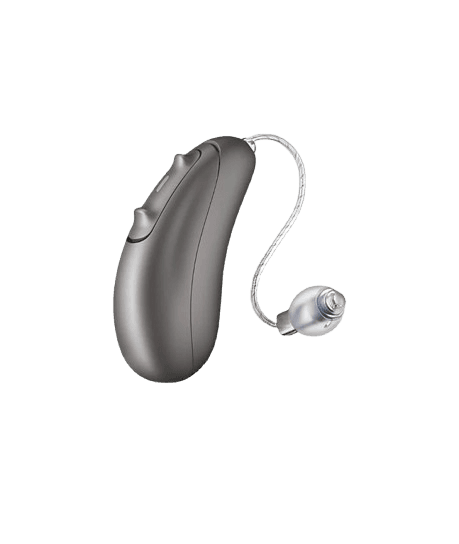
Not everyone needs a premium chip. Orion is a simple rechargeable RIC at ₹32,990 to ₹42,990 per unit (the charger is ₹4,490 extra), and for mild to moderate SNHL in a mostly quiet routine it does the job. Other budget options on the 2026 lists include Signia Intuis 3 BTE at ₹26,990 and Phonak Terra+ RIC at ₹42,000, or ₹62,000 for the rechargeable version.
Other brands worth a trial
Oticon, Widex, ReSound, Starkey and Bernafon all make good aids for SNHL, and an audiologist may suggest one of them after your fitting. Their prices are in our Oticon price guide, Widex price guide and Starkey vs ReSound comparison, and the hearing aid price guide for India lists every brand together. For Signia and Phonak in full, see the Signia price guide and Phonak price guide.
How to Choose a Hearing Aid for Sensorineural Loss
Start from the audiogram rather than from a brochure. The degree and the shape of your loss decide the style and power you need, and a loss that slopes steeply into the high pitches needs a different fitting from a flat one.
- Fit both ears if both have SNHL. Two aids help you tell where sound comes from and cope with noise much better than one.
- Pick the technology level by how noisy your days are, not by price alone. Quiet home life, entry or mid level; office, travel and gatherings, mid or premium.
- Go rechargeable if small batteries are hard to handle, and check Bluetooth support if you take calls.
- Ask whether a RIC or BTE suits your degree; invisible CIC and IIC aids only suit milder losses.
- Allow a few weeks to adjust, with follow-up fine-tuning. The brain needs time to get used to sounds it has not heard clearly for years.
Our guides on choosing the right digital hearing aid and getting the best hearing aids go deeper, and the compare tool lines up models side by side.
Get Tested at a Hearwell Clinic

Hearwell audiologists do full audiograms, explain your report in plain words and let you try Signia, Phonak and other brands at home for 7 days. Visit us in Jalandhar, Phagwara, Kapurthala, Ludhiana, Bathinda, Mohali, Patiala or Jammu, or see our pages for Delhi NCR, Amritsar and Hoshiarpur. You can also browse all hearing aids or contact us.
Frequently Asked Questions

What is sensorineural hearing loss?
It is hearing loss caused by damage to the inner ear (the cochlea’s hair cells) or the hearing nerve. Sound reaches the inner ear but is not turned into clear signals for the brain. It is the most common type of permanent hearing loss.
Is sensorineural hearing loss curable?
Gradual sensorineural loss is usually permanent because damaged hair cells do not grow back. It is treated, not cured, mainly with hearing aids. Sudden sensorineural hearing loss is different and can sometimes recover with early steroid treatment, so see an ENT doctor within days.
What is the best treatment for sensorineural hearing loss?
For mild to severe loss, properly fitted digital hearing aids in both ears. For severe to profound loss where aids no longer make speech clear, a cochlear implant may be considered.
What are the main causes of sensorineural hearing loss?
Ageing (presbycusis) and long exposure to loud noise are the most common. Others include ototoxic medicines, infections such as meningitis or mumps, genes, Meniere’s disease and head injury.
Which hearing aid is best for sensorineural hearing loss?
It depends on the degree. Our top picks for 2026 are Signia Pure Charge&Go IX and Phonak Audéo Infinio for mild to severe loss, Signia Motion Charge&Go IX and Phonak Naída L-PR for severe loss, and Signia Orion Charge&Go as a budget choice.
What is bilateral sensorineural hearing loss?
Sensorineural loss in both ears. It is the usual pattern with age- and noise-related loss, and it is best treated with a hearing aid in each ear.
Can sensorineural hearing loss get worse?
Yes, age-related loss usually progresses slowly over years, and noise or ear-harming medicines can speed it up. Protecting your ears and having a hearing test every year or two helps keep your hearing aids set correctly.
How much does a hearing aid for sensorineural hearing loss cost in India?
On the 2026 price lists, from about ₹26,990 for a basic Signia BTE and ₹32,990 for a rechargeable Signia Orion RIC, up to ₹3 lakh or more per unit for premium models such as Signia Pure Charge&Go 7IX (₹3,89,990).
This article is for general information and does not replace a medical opinion. Sudden hearing loss, hearing loss in one ear, ear pain, discharge or dizziness should be checked by an ENT doctor.
Been Told You Have Sensorineural Hearing Loss?
Bring your report or book a free hearing test at any Hearwell clinic. We will explain your audiogram and let you try Signia and Phonak hearing aids for 7 days before you decide.
Call: +91 8556086888 | WhatsApp: wa.me/+918556086888 | Find your nearest Hearwell clinic