Choosing a hearing aid brand can feel a lot like choosing a smartphone ecosystem once you pick one, you’re often in it for years, tied to its app, its accessories, and its way of solving problems. Two of the biggest names dominating that decision in 2026 are Signia and Phonak. Both are backed by hearing-tech giants (Signia by WSAudiology, Phonak by Sonova), both push AI-driven sound processing as their headline feature, and both have loyal followings among audiologists.
But they are not the same product wearing a different logo. Signia leans into speech clarity in group conversations and a huge range of styles, including some of the most invisible custom aids on the market. Phonak leans into raw processing power, industry-first AI chips, and a platform built for people who move through a lot of different, unpredictable environments.
This guide breaks down how the two brands actually differ, compares their current flagship and mid-range models, and helps you figure out which one fits your lifestyle, budget, and hearing loss before you even walk into a clinic. If you’d rather skip the research and compare real devices side by side, Hearwell Hearing Solution also offers a model comparison tool and free audiologist consultation.
A Quick Snapshot: Signia vs Phonak at a Glance
| Signia | Phonak | |
|---|---|---|
| Parent company | WSAudiology (formerly Siemens) | Sonova |
| Current top platform | Integrated Xperience (IX) | Infinio / Audéo EON Sphere |
| Signature technology | RealTime Conversation Enhancement | DEEPSONIC AI chip (Sphere mode) |
| Style range | Very wide — BTE, RIC, CIC, earbud-style, bone conduction | Wide — RIC, BTE, custom ITE/CIC |
| Best known for | Group conversation clarity, tinnitus therapy | Speech-in-noise performance, rugged reliability |
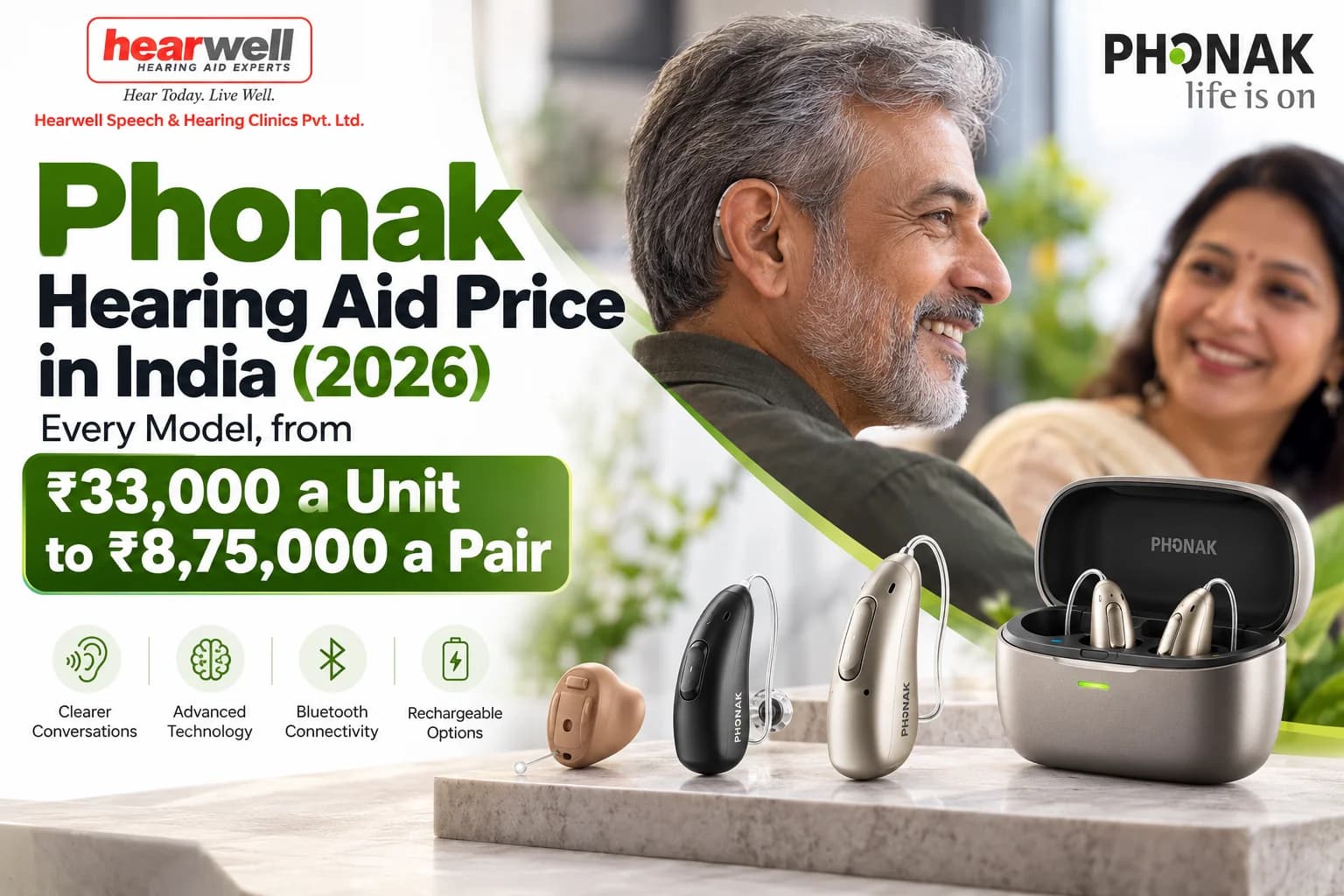
| Price range | Roughly ₹75,000–₹1,60,000 (varies by market) | Roughly 10,000–4,50,000 per pair (varies by region and tier) |
Signia’s Current Lineup: Built Around the IX Platform

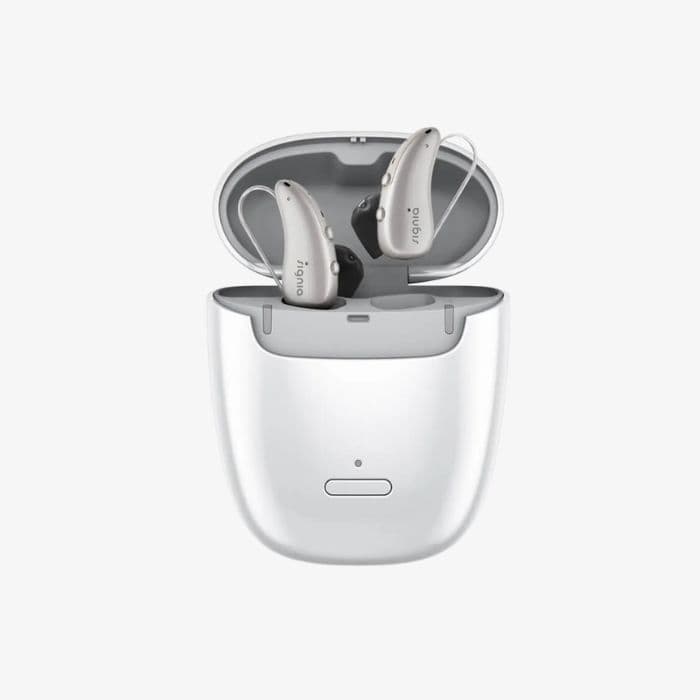
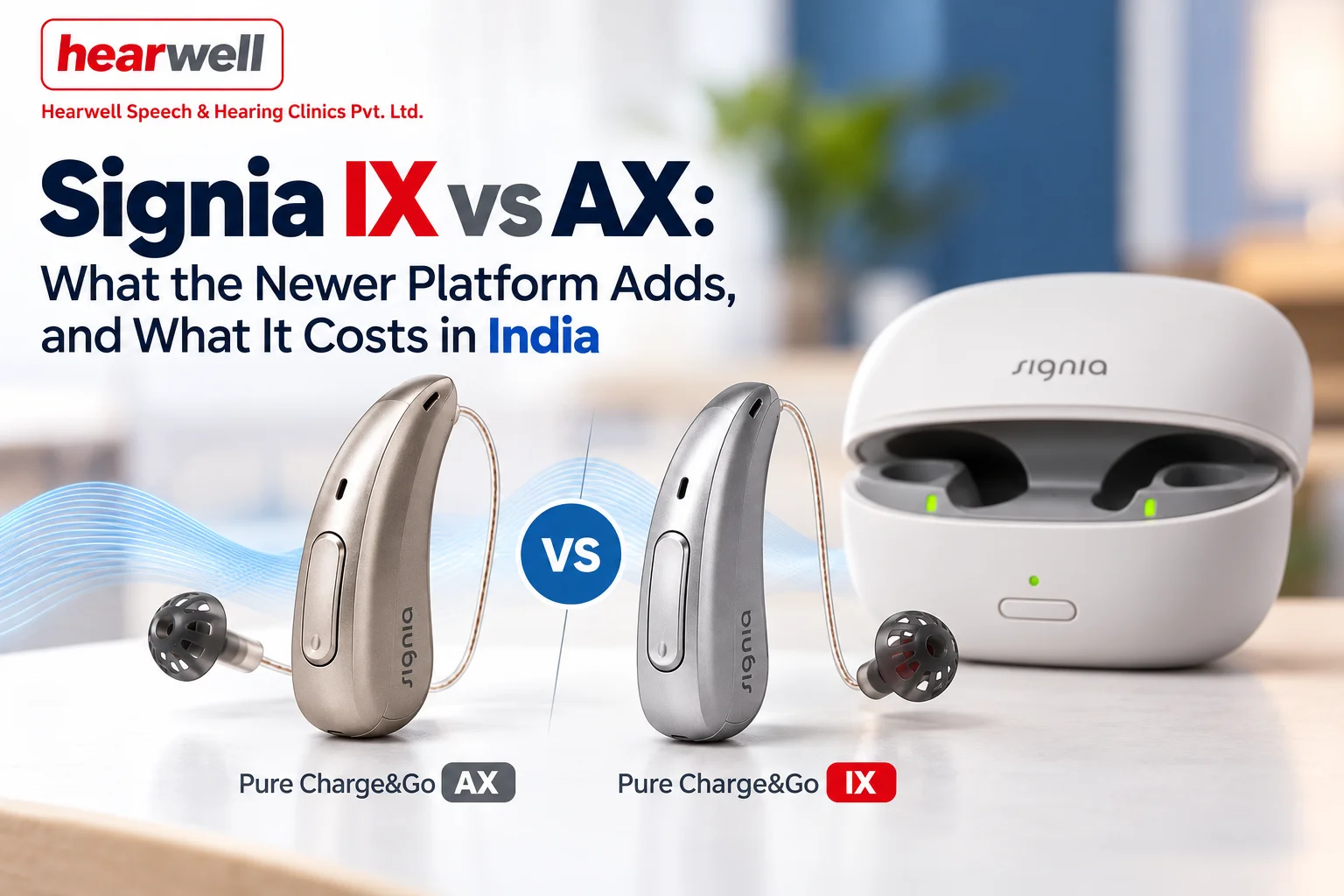
Signia’s Integrated Xperience (IX) platform underpins its current generation, with the Motion Charge&Go IX line launched in September 2025 as a rechargeable behind-the-ear family built for people with more severe hearing loss. The IX platform is Signia’s answer to a very specific problem: keeping up when more than one person is talking at once.
Top Signia models to know:
- Pure Charge&Go 7IX / MaX — the flagship model, designed to make it easier to follow group conversations where more than one person is speaking at a time and to clarify speech even in noisy settings. It’s the go-to pick if you regularly find yourself in family dinners, meetings, or busy restaurants.
- Styletto IX — Signia’s fashion-forward, slim RIC design, paired with a sleek portable charging case. It’s aimed at people who want performance without the aid looking like a medical device.
- Silk Charge&Go IX — a completely-in-canal (CIC) hearing aid designed to be almost invisible, ready to wear with no custom mold required.
- Active Mini IX — launched in July 2026, this brings true-wireless-earbud styling to a smaller, lower-profile design for people who want discretion without a custom mold, and includes RealTime Conversation Enhancement that adapts as conversations shift between speakers.
- Pure Charge&Go BCT 7IX — uses Bone Conduction Technology to transmit sound through the bones of the skull directly to the inner ear, bypassing the ear canal entirely, making it a notable option for single-sided deafness or conductive hearing loss.
Across the range, battery life is a strong point Signia’s Pure Charge&Go IX models are rated for a robust 39-hour battery life and support hands-free calling with iOS and Android streaming. And the IX lineup spans everything from earbud-style rechargeable aids to fully custom, invisible-in-canal options, with power and realism scaling from the entry-level 3IX up to the premium 7IX tier. You can browse the full range, with current pricing, on Hearwell’s Signia catalog.
Phonak’s Current Lineup: Infinio, Sphere, and the New EON

Phonak’s naming can be confusing right now because the brand is mid-transition between two platforms.
Top Phonak models to know:
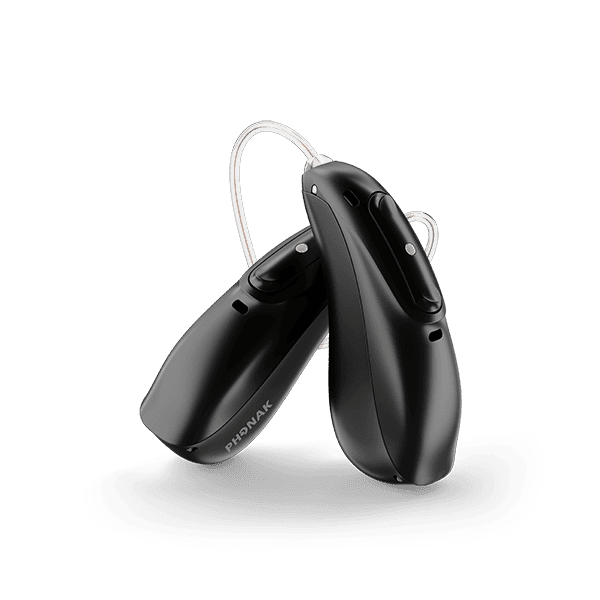
- Audéo Infinio Ultra Sphere — the current flagship for most of 2025–2026. It runs on Phonak’s new ERA chip and adds a dedicated AI processor called DEEPSONIC specifically for separating speech from background noise an industry first with independent testing ranking it first for speech-in-noise performance among prescription hearing aids tested.
- Audéo Lumity L90-R / L70-R — the L90-R is a top-tier option for communicating in challenging, noisy environments, while the L70-R offers strong performance with slightly fewer features at a lower price point.
- Virto R Infinio — a custom in-the-ear model recognized alongside the Infinio Ultra Sphere for design and AI innovation.
- Virto Paradise — a custom-made in-the-ear hearing aid built to be as unnoticeable as possible, ideal for anyone who wants a smaller, discreet device.
- Audéo EON Sphere / Audéo E R — the newest 2026 releases, positioned as Phonak’s latest generation and the first to bring direct Android and iOS streaming on the very newest hardware.
A recent firmware update also matters here: a free update in October 2025 improved battery efficiency by 30% and upgraded Phonak’s AutoSense environmental-detection system to version 7.0, trained on 18 times more real-world listening scenarios. That’s a meaningful upgrade even for people who already own an Infinio-generation device.
Worth noting: the top-tier Sphere model can be pricier and slightly bulkier because of its extra chip, and battery life drops noticeably when the advanced AI mode runs constantly. You can see current models and pricing on Hearwell’s Phonak catalog.
Head-to-Head: Where the Two Brands Really Differ
1. Group conversations vs. noisy environments. Signia’s engineering story is about conversation dynamics following multiple speakers as attention shifts. Phonak’s is about noise separation isolating one voice from chaotic background sound using a dedicated AI chip. If your struggle is a loud restaurant table with cross-talk, Phonak’s Sphere technology is arguably the more targeted tool. If your struggle is a family gathering where the “important” voice keeps changing, Signia’s RealTime Conversation Enhancement is built for exactly that.
2. Style and invisibility options. Signia currently has the edge in sheer variety the brand has close to ten models available, spanning receiver-in-canal styles, custom in-the-ear designs, and the sleek Silk Charge&Go IX plus a bone-conduction option that Phonak doesn’t currently match. Phonak’s custom range (Virto Paradise, Virto R Infinio) is strong but slightly narrower.
3. Battery and connectivity. Both brands are competitive, but they optimize differently. Signia advertises long flat battery life (39 hours) as a baseline feature across its rechargeable range. Phonak’s newest firmware focuses on efficiency gains for AI-heavy processing, which matters more if you’ll actually use Sphere mode all day.
4. Price and accessibility. Phonak’s pricing tends to span a wider range from around 10,000 to 4,50000 per hearing aid depending on features and technology level, giving more room to step down to a budget tier without switching brands. Signia’s range is similarly tiered by technology level, with premium IX or AX models costing more than entry-level equivalents.
5. Tinnitus and specialty needs. Signia has built a strong reputation specifically for tinnitus management features integrated into its devices, which is worth a special look if tinnitus is a major part of what you’re treating not just hearing loss on its own.
Signia vs Phonak: India Retail Price List Comparison (2026)
If you’re shopping in the Indian market, here’s how the two brands actually stack up on MRP, based on official 2026 retail price lists. Note that a “Kit” refers to a pair of hearing aids plus a charger, while a per-unit price is for a single hearing aid.
Flagship / Premium RIC Models
| Tier | Signia (Integrated Xperience) | Price (Kit) | Phonak (Infinio) | Price (Kit) |
|---|---|---|---|---|
| Top-of-line | Pure Charge&Go BCT 7IX (bone conduction) | ₹7,99,990 | Audéo Sphere Infinio 90 | ₹8,75,000 |
| Standard flagship | Pure Charge&Go 7IX / T7IX | ₹7,69,990 | Audéo R Infinio 90 (with ChargerGo) | ₹6,76,000 |
| Style-focused flagship | Styletto 7IX | ₹7,24,990 | — |
Mid-Tier RIC Models
| Level | Signia | Price (Kit) | Phonak | Price (Kit) |
|---|---|---|---|---|
| 5IX / 70 | Pure Charge&Go 5IX / T5IX | ₹4,79,990 | Audéo R Infinio 70 (ChargerGo) | ₹4,50,000 |
| 5IX / 70 Sphere | — | — | Audéo Sphere Infinio 70 | ₹5,90,000 |
| 3IX / 50 | Pure Charge&Go 3IX / T3IX | ₹3,46,990 | Audéo R Infinio 50 (ChargerGo) | ₹2,62,000 |
Entry-Tier RIC Models
| Level | Signia | Price (Kit) | Phonak | Price (Kit) |
|---|---|---|---|---|
| 1IX / 30 | Pure Charge&Go 1IX / T1IX | ₹1,44,990 | Audéo R Infinio 30 (ChargerGo) | ₹1,60,000 |
Custom In-the-Ear / CIC Models
| Level | Signia | Price (Kit) | Phonak | Price (Kit) |
|---|---|---|---|---|
| Flagship custom | Insio Charge&Go CIC 7IX | ₹7,69,990 | Virto I90-R (ITC) | ₹6,30,000 |
| Entry custom | Insio Charge&Go CIC 1IX | ₹1,44,990 | Virto I30-R (ITC) | ₹1,44,000 |
What the Pricing Tells Us
- At the very top, Phonak’s Audéo Sphere Infinio 90 is the single most expensive model in either lineup at ₹8,75,000, driven by its dedicated DEEPSONIC AI chip. Signia’s closest rival, the BCT 7IX, adds bone-conduction technology rather than being a direct like-for-like match.
- Standard flagship RIC vs RIC, Signia’s Pure Charge&Go 7IX (₹7,69,990) runs noticeably higher than Phonak’s non-Sphere Audéo R Infinio 90 (₹6,76,000), though it lands close to Phonak’s Sphere-tier pricing.
- Custom/invisible models follow the same pattern Signia’s Insio flagship (₹7,69,990) costs more than Phonak’s comparable Virto flagship (₹6,30,000).
- Entry-level models are the closest in price across both brands, within about ₹15,000 of each other.
- Accessories differ too — a Signia Styletto/Silk charger runs ₹11,990, while Phonak’s comparable ChargerGo unit is priced at ₹18,000.
Note: Prices reflect official MRP from Signia’s retail price list (effective 17th March 2026) and Phonak’s Infinio-era price list, and may vary by city, clinic, and any ongoing promotions. GST treatment also differs between hearing aids (exempt) and accessories (applicable), so always confirm final billed price with your local provider. For an updated quote and any active offers, you can request Hearwell’s latest price list.
Which One Should You Choose?
- Choose Signia if: you spend a lot of time in group settings (family dinners, meetings, classrooms), you want the widest range of styles including near-invisible or bone-conduction options, or tinnitus relief is a priority alongside hearing loss.
- Choose Phonak if: your main challenge is isolating speech in loud, chaotic noise (restaurants, traffic, crowds), you want the newest AI chip technology on the market, or you want more flexibility across a wide price range within one brand.
In both cases, the model name on the box matters less than it seems. A hearing aid only performs at its best when it’s fitted correctly, and getting a proper hearing test and professional fine-tuning often makes a bigger difference than which model you chose. Whichever brand you lean toward, try to demo both in person, in the environments where you actually struggle most, before committing. Hearwell Hearing Solution is an authorised partner for both Signia and Phonak and offers a free hearing test plus a 7-day trial, so you can compare the two brands on your own ears before deciding.
FAQ: Signia vs Phonak

1. Which brand is better overall, Signia or Phonak? Neither is objectively “better” they’re optimized for different problems. Phonak’s Infinio/Sphere platform is generally considered stronger for isolating speech in loud, unpredictable noise. Signia is generally considered stronger for following multiple speakers in group conversation and offers a wider range of styles, including bone-conduction and near-invisible options.
2. Are Phonak hearing aids more expensive than Signia? Pricing overlaps significantly and varies heavily by country, technology tier, and provider. Phonak’s range runs roughly $1,000–$4,500 per aid depending on tier, while Signia’s premium and entry models span a similarly wide range. Get quotes locally rather than assuming one brand is universally cheaper.
3. What is Phonak’s DEEPSONIC chip? It’s a dedicated AI processor found in Phonak’s Sphere-tier devices that works specifically to separate speech from background noise in real time, rather than just adjusting general settings something Phonak markets as an industry first.
4. What is Signia’s RealTime Conversation Enhancement? It’s a feature built into Signia’s newer IX-platform devices, including the Active Mini IX, designed to automatically adapt as conversations shift between different speakers in a group setting.
5. Does either brand make an invisible hearing aid? Yes, both do. Signia’s Silk Charge&Go IX is a completely-in-canal design meant to be almost invisible with no custom mold needed. Phonak’s Virto Paradise and Virto R Infinio are custom in-the-ear options built for similar discretion.
6. Can I switch from Phonak to Signia (or vice versa) later? Yes, hearing aids aren’t tied to a single ecosystem the way some other devices are. However, switching brands usually means a new fitting, new companion app, and a period of adjustment, so it’s worth choosing carefully the first time.
7. Do both brands work with iPhone and Android? Yes. Both Signia and Phonak’s current-generation devices support direct Bluetooth streaming for calls and audio on modern iOS and Android devices, though exact compatibility can depend on the specific model and phone OS version.
8. Which brand is better for tinnitus? Signia has a particularly strong reputation for tinnitus-specific features built into its hearing aids, making it a common recommendation for people managing tinnitus alongside hearing loss though Phonak also offers tinnitus-management options worth asking about.
9. Do I need to see an audiologist to choose between them? Yes, strongly recommended. Neither brand comparison substitutes for a professional hearing test. The right choice depends on your specific hearing loss profile, ear anatomy, and lifestyle, and both brands perform best when properly fitted and fine-tuned by a hearing care provider. You can book a free hearing test with Hearwell’s certified audiologists to get a personalized recommendation.